
Expert Consensus Lists Vitamin C Among Safer Options When Melasma and Vitiligo Overlap
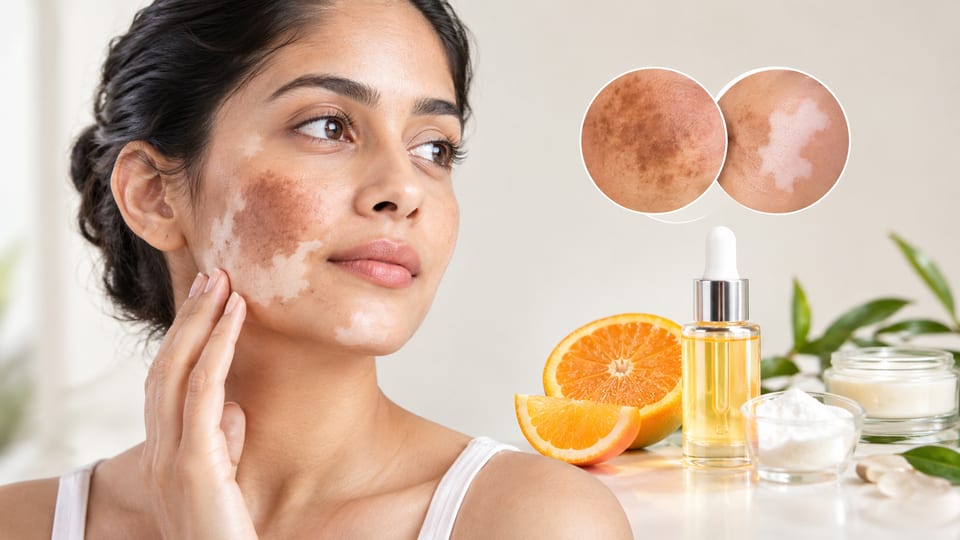
Melasma and vitiligo pull skin in opposite directions: one is too much pigment, the other is lost pigment. When a person has both, a cream that fades melasma by slowing pigment cells can, in theory, put more stress on the fragile pigment cells that vitiligo is already attacking. Until now there was no agreed guidance on how to treat the two together.
A consensus paper in the November 2026 issue of Pigment Cell & Melanoma Research tries to fill that gap. The authors first reviewed the published literature up to June 2023 and found it thin: only one study supported a melasma treatment, oral tranexamic acid, as safe in people with vitiligo. They then ran a two-round online Delphi survey of 22 pigment specialists from 14 countries, counting a point as agreed when at least 70% of the panel backed it, and finished with a consensus meeting. The panel included dermatologists from PGIMER Chandigarh, Ain Shams University in Cairo, and centres in Europe, Asia, Africa, Australia and the Americas.
The panel's main advice is to treat vitiligo first, especially when it is active, while taking the patient's own priorities into account. Topical calcineurin inhibitors, ruxolitinib, tretinoin, corticosteroids and oral tranexamic acid were judged usable, while lasers and chemical peels were recommended only with caution and only by experienced pigment specialists.
For everyday brightening, the experts suggested that hydroquinone be replaced by safer cosmetic lightening agents, naming niacinamide, ascorbic acid, thiamidol and melasyl. They wrote that these show comparable efficacy with less theoretical risk, a judgement the panel itself says needs proper head-to-head studies in vitiligo-prone skin.
For readers, the practical point is narrow. This is expert opinion, not a trial, and it applies to people who have both conditions. Anyone with vitiligo should check with a dermatologist before starting any brightening product, including a vitamin C serum. We read the published abstract; the full paper is behind a paywall.
AI-assisted summary, rewritten from reporting by Pigment Cell & Melanoma Research (abstract via PubMed).
Read the original article at Pigment Cell & Melanoma Research (abstract via PubMed)Compare vitamin C serums sold in India → or read our vitamin C guides and ingredient explainers.
More vitamin C news
- Senté's Vitamin C Serum Study: What 16 Participants Can and Cannot Show
- Dior Pairs PDRN With Vitamin C in New Capture PDRN-Shot Booster
- Which? Puts 12 Vitamin C Serums Through Lab Tests for Strength and pH
- Lab Study Tests Ethyl Ascorbic Acid, the Vitamin C in Many Indian Serums, on Human Fibroblast Cells
We are not dermatologists. This content is for informational purposes only — consult a qualified professional for medical advice.