
Hidden Steroids in Brightening Creams and Serums: Warning Signs and Why They Matter
Some fast-acting fairness and brightening products owe their results to undeclared prescription steroids. Here is how steroid damage shows up on the face, why stopping is hard, and how to choose safer products.
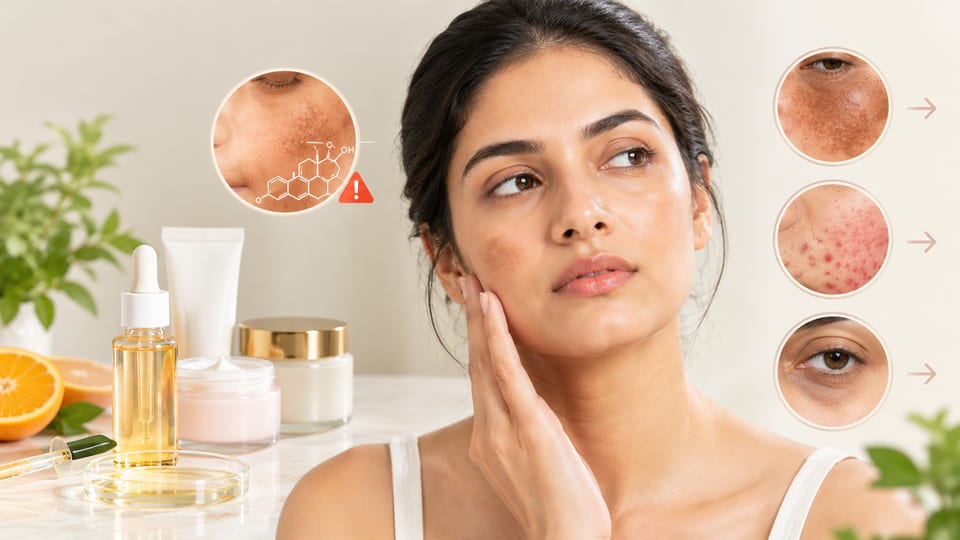
Most brightening serums work slowly. A vitamin C serum, used every morning under sunscreen, may make skin look a little more even over several weeks. So when a cream or serum promises dramatically fairer, clearer skin within days, it is worth asking what is really doing the work. Repeatedly, the answer has turned out to be a strong prescription steroid that is not on the label.
Why steroids end up in face products
Topical corticosteroids are genuine medicines. Prescribed for a short course, they calm eczema and other inflammatory rashes. On the face, though, they can also temporarily lighten skin, shrink redness and quieten acne, which makes them attractive to anyone selling a fast result. Indian dermatologists have documented this for years. A review in the Indian Journal of Dermatology describes steroids being used on the face as fairness creams, for melasma and other dark patches, and for acne, frequently on the advice of friends, relatives, beauticians or a chemist rather than a doctor, and often in combination creams that pair a steroid with a lightening agent, an antifungal or an antibiotic.
A product does not have to be sold as a medicine to contain one. Laboratory studies of online skin products have found potent steroids such as clobetasol hidden in creams and serums marketed for brightening, eczema or psoriasis, with nothing on the ingredient list to warn the buyer. A familiar ingredient on the label, vitamin C included, is no guarantee that the formula is what it claims to be.
What steroid damage looks like
Dermatologists call long-term harm from misused steroids on the face topical steroid damaged or dependent face. The commonest sign is persistent redness. Other features described in the Indian literature include:
- acne-like bumps and pustules, often around the mouth or nose
- visible small blood vessels (telangiectasia)
- thinning, shiny or easily irritated skin
- new patches of lighter or darker skin
- increased facial hair
- burning or stinging, and new sensitivity to sunlight
- fungal infections that look unusual because the steroid has masked them
Strong steroids used near the eyes carry extra risks, including raised eye pressure, and heavy long-term use over large areas can affect the body's own hormone balance.
Why stopping is hard
The cruel part is dependence. When the product is stopped, the skin often flares: redness, burning and peeling that can look worse than the original problem. That rebound pushes people back to the cream, which seems to fix it, and the cycle continues. Specialists describe the flares as easing and spacing out over time once the steroid is stopped for good, but this is a process that needs a dermatologist's support, counselling and sometimes other medicines to control the rebound. Doctors differ on whether to taper or stop at once, which is one more reason not to manage it alone.
Red flags when choosing a brightening product
- Very fast promises. Claims of visibly fairer or spotless skin in a few days are unusual for genuine cosmetic actives.
- A missing or vague ingredient list. Legitimate cosmetics sold in India must carry a full ingredient list and the manufacturer's details.
- Unbranded or untraceable sellers. Products imported informally or sold only through anonymous online listings are harder to hold to any standard.
- Medicated combinations used as cosmetics. A cream bought from a chemist that mixes a steroid with other drugs is a prescription medicine, not a daily moisturiser.
- Skin that looks great until you stop. If your face flares every time you skip a product, tell a dermatologist and take the tube with you.
Where vitamin C fits
A vitamin C serum from a brand that lists its full formula is one of the gentler ways to work on dullness and sun-related spots, and it pairs naturally with daily broad-spectrum sunscreen, which dermatologists consider essential for any pigmentation problem. Its effect is gradual, and that is normal. If you want help comparing serums, our vitamin C serum list shows each product's source, size and current details, and our guide to reading vitamin C serum claims explains which promises deserve scepticism.
For melasma or stubborn dark patches, the most effective treatments are prescription products used under supervision. A dermatologist can use them safely for a limited time. A cream that quietly does the same thing, with no supervision and no end date, cannot.
Compare vitamin C serums sold in India → or browse ingredient explainers and picks by skin type and budget.
More from the blog
- Vitamin C Serum and Air Pollution: What an Antioxidant Can and Cannot DoSkin Concerns · 4 min read
- Can a Vitamin C Serum Help Dark Circles? It Depends on Which Kind You HaveSkin Concerns · 4 min read
- Vitamin C and Visible Light: What a Serum Can and Can't Do for Pigmentation in Darker SkinSkin Concerns · 4 min read
- Vitamin C Serum Side Effects: Tingling, Stinging and When to StopSkin Concerns · 3 min read
We are not dermatologists. This content is for informational purposes only — consult a qualified professional for medical advice. See our editorial policy and medical disclaimer.