
Vitamin C Serum and Air Pollution: What an Antioxidant Can and Cannot Do
Pollution is often blamed for dull skin and dark spots, and vitamin C serums are sold as a shield. Here is what the research actually shows about pollution, skin and topical antioxidants, and which steps matter more.
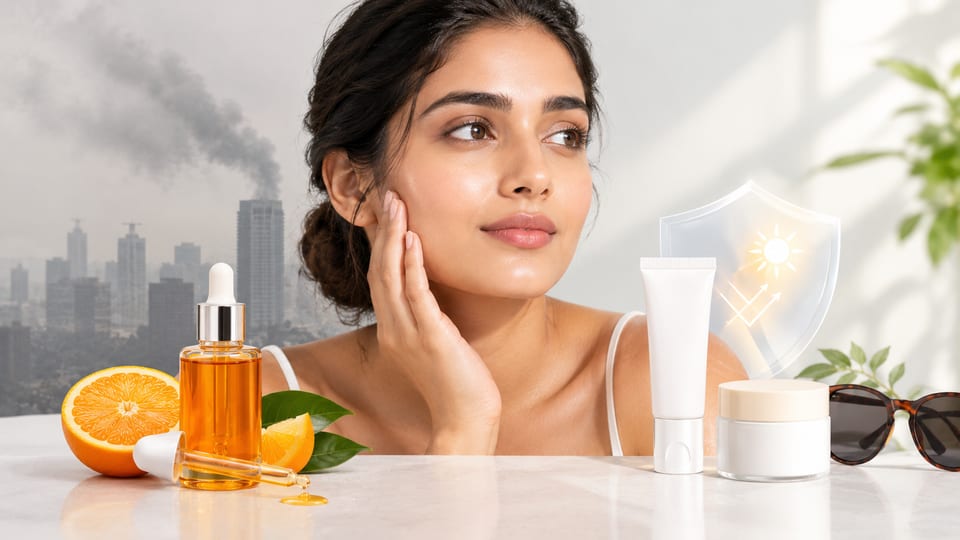
Anyone who lives in a big Indian city knows the feeling of grimy skin at the end of the day. Pollution is now a common explanation for dullness, uneven tone and early lines, and many vitamin C serums are marketed as protection against it. The science behind that idea is real but thinner than the labels suggest. This guide sets out what is reasonably well established, what is still uncertain, and how to build a routine that does not depend on hope.
How pollution reaches the skin
Researchers usually group outdoor air pollution into a few families. Fine particles, often called PM2.5 and PM10, come from traffic, construction, industry and burning fuel. Polycyclic aromatic hydrocarbons are chemicals formed when fuel, wood or tobacco burns, and they often ride on those particles. Ground-level ozone forms when sunlight acts on vehicle and industrial emissions, so it tends to peak on bright afternoons. Nitrogen dioxide comes mainly from traffic. Indoors, smoke from cooking on wood, coal or other solid fuels adds its own load.
These pollutants land on the skin surface and can interact with the outermost layer. Some may also reach the skin from inside the body after being breathed in. How far particles penetrate healthy, intact skin is still debated among scientists.
What pollution seems to do
The main proposed mechanism is oxidative stress. Ozone reacts with fats and protective antioxidants in the top layer of skin and creates reactive by-products. In a controlled experiment where volunteers' forearms were exposed to ozone, the vitamin E in that layer dropped sharply within a couple of hours. Loss of vitamin C from skin after ozone has been shown in mice. In cell studies, particles trigger reactive oxygen species and inflammatory signals in skin cells, and some combustion chemicals become more damaging when combined with UVA light.
Studies of people point in the same direction but are observational. A long-running study of older women in Germany linked higher exposure to traffic-related particles with more pigment spots and deeper wrinkles. Studies in Germany and China linked nitrogen dioxide with more pigment spots on the cheeks, and research in Chinese women linked cooking with solid fuels to more wrinkles. These findings show associations, not proof that pollution alone caused the changes, and the pollutants are hard to separate from one another or from sun exposure.
Where vitamin C fits
Vitamin C is an antioxidant, so it is a logical candidate to soak up some of this oxidative stress. In laboratory work, skin cells pretreated with vitamin C mixtures, including one combined with vitamin E and ferulic acid, were better protected from ozone damage. In a small study on human forearm skin exposed to ozone for several days, areas treated with topical antioxidant mixtures showed lower levels of oxidation markers and smaller changes in some ageing-related signals than untreated areas.
That is encouraging, but it is not the same as showing that a serum prevents pigment spots or wrinkles caused by pollution. No large clinical trial has tested that. An independent review of the evidence, written by public-health researchers, concluded that the benefit of supplements and topical products against pollution remains unproven. Most of the supporting work used cells, mice or short exposures. If a brand claims its serum blocks a specific percentage of pollution, ask what was tested and on what.
If you already use vitamin C for brightening, there is no harm in applying it in the morning, when it can sit on the skin through the day's exposure. Choose a formula you tolerate and will use consistently. Our guide to vitamin C forms explains the differences, and current options are on the serums page.
Steps with stronger backing
- Sunscreen every morning. UV light drives much of visible skin ageing and appears to make some pollution damage worse. In a long Australian trial, people who used sunscreen daily showed no measurable increase in skin ageing over four and a half years, unlike those who used it only now and then. Apply vitamin C first, then sunscreen.
- Cleanse at night. A gentle cleanse removes particles, sunscreen and grime that have built up during the day. Harsh scrubbing is not needed and can damage the barrier.
- Look after the barrier. A simple moisturiser helps the outer layer stay intact, which is the skin's own first defence.
- Reduce exposure where you can. Good kitchen ventilation and cleaner cooking fuels reduce indoor smoke, and avoiding the busiest roads at peak traffic lowers what reaches your face and lungs.
Reading anti-pollution claims
Anti-pollution is a marketing category, not a regulated claim. Many products use the phrase based on lab tests that show reduced particle adhesion or antioxidant activity in a dish. Those tests can be useful for development, but they do not tell you how your skin will look after months of use. Our guide on reading vitamin C serum claims walks through the questions to ask.
The researchers behind the review made one more point worth remembering: the most effective protection against air pollution is cleaner air. A serum can be a sensible part of a morning routine, but it is a supporting act. Sunscreen, gentle cleansing and a healthy barrier do more of the work.
Compare vitamin C serums sold in India → or browse ingredient explainers and picks by skin type and budget.
More from the blog
- Hidden Steroids in Brightening Creams and Serums: Warning Signs and Why They MatterSkin Concerns · 3 min read
- Can a Vitamin C Serum Help Dark Circles? It Depends on Which Kind You HaveSkin Concerns · 4 min read
- Vitamin C and Visible Light: What a Serum Can and Can't Do for Pigmentation in Darker SkinSkin Concerns · 4 min read
- Vitamin C Serum Side Effects: Tingling, Stinging and When to StopSkin Concerns · 3 min read
We are not dermatologists. This content is for informational purposes only — consult a qualified professional for medical advice. See our editorial policy and medical disclaimer.