
Vitamin C Serum Concentration: Is 10%, 15% or 20% Right for You?
A higher number on the bottle is not automatically a better serum. Here is what 10%, 15% and 20% actually change, and how to pick a strength your skin will tolerate long enough to see a result.
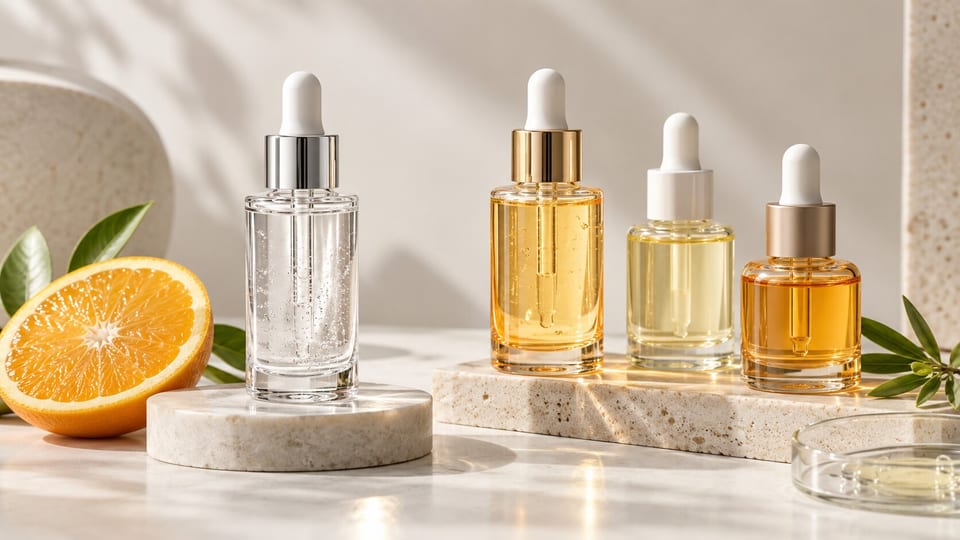
The percentage on a vitamin C serum tells you how much vitamin C the formula contains by weight. It does not tell you how much your skin will absorb, how stable the formula is, or how well you will tolerate it — and those three things decide whether you see a result.
What the percentage actually measures
A 15% serum contains 15 grams of vitamin C per 100 grams of product. That is a useful number only when you also know which vitamin C is in there. Pure L-ascorbic acid at 15% behaves nothing like 15% of a gentler derivative such as sodium ascorbyl phosphate, because the two differ in how readily they cross the skin barrier and how quickly they break down in the bottle.
So read the percentage together with the form. On every product page we list both — see all serums for the side-by-side.
The practical ranges
Around 10%
A sensible starting point, and often the right long-term strength for drier or reactive skin. Low enough that most people can use it daily without stinging, which matters more than the number itself: a 10% serum you apply every morning will out-perform a 20% serum that sits unused because it burns.
Around 15%
The middle ground most brands converge on. Noticeably more active than 10% while still tolerable for a lot of people once skin has adjusted over a few weeks.
20% and above
The commonly cited formulation guidance is that absorption of L-ascorbic acid does not keep climbing indefinitely with concentration — past roughly the 20% mark you add irritation without adding much benefit. Higher numbers are also harder to keep stable, so a very high-percentage serum that has been open for months may be delivering less than a fresher, weaker one.
Why the number is not the whole formula
- pH. L-ascorbic acid only penetrates well in an acidic formula. A 20% serum at the wrong pH underperforms a well-built 10% one. We cover this in why pH decides whether your serum works.
- Form. Derivatives trade some potency for stability and gentleness. Compare the main forms here.
- Packaging. An airless pump protects the active far better than a wide dropper bottle. See packaging and shelf life.
- Supporting antioxidants. Vitamin E and ferulic acid are commonly added because they help stabilise the formula alongside their own effects.
How to choose, practically
- New to vitamin C? Start around 10%, every other morning, and build to daily over two to three weeks. Our beginner guide walks through the ramp-up.
- Sensitive or easily flushed? Consider a derivative instead of chasing a percentage. Picks for sensitive skin.
- Already tolerate 10% daily with no irritation? Moving to 15% is a reasonable next step if you want more, but it is optional, not an upgrade you owe your skin.
- Mainly after antioxidant protection? Consistency and sunscreen matter more than strength. See layering with SPF.
Signs you have gone too strong
Stinging that lasts beyond a minute or two, lingering redness, tightness, or small flaky patches around the nose and mouth all suggest dropping the strength or the frequency. Irritated skin is not "purging" its way to a result — we cover what is and is not normal in side effects and when to stop.
The short answer
Pick the highest concentration you can use consistently without irritation, and treat everything else on the label — form, pH, packaging, freshness — as equally important. A 10% serum used every day for three months will do more for your skin than a 20% one used twice.
Common questions
Is 20% vitamin C too strong for daily use?
For a lot of people, yes, especially as a starting point. Absorption of L-ascorbic acid does not keep rising indefinitely with concentration while irritation does, so 20% daily often costs more tolerance than it returns. If you want to try it, build up from a lower strength first.
Can I start directly with 15%?
If your skin already handles acids comfortably, 15% every other morning is a reasonable start. If you have never used vitamin C or any acid, 10% is the safer entry point.
Does a higher percentage fade dark spots faster?
Not reliably. Consistency and daily sunscreen move pigmentation far more than the number on the bottle, and an irritated barrier can make tone look worse rather than better.
Is 5% vitamin C worth using?
Yes, particularly as a derivative formula for sensitive skin or as a first step before moving up. A 5% serum used every day is more useful than a 20% one you cannot tolerate.
Compare vitamin C serums sold in India → or browse ingredient explainers and picks by skin type and budget.
More from the blog
- How to Read the Efficacy Claims on a Vitamin C SerumGuide · 2 min read
- Airless Pump vs Dropper Bottle: Why Vitamin C Packaging Decides Shelf LifeGuide · 3 min read
- Why Vitamin C Serums Are Starting to Add Carnosine and Other Anti-Glycation ActivesIngredients · 3 min read
- Nine Vitamin C Serum Myths Worth DroppingMyths · 3 min read
We are not dermatologists. This content is for informational purposes only — consult a qualified professional for medical advice. See our editorial policy and medical disclaimer.