
Vitamin C Serum pH: Why It Decides Whether Your Serum Works
pH is the number brands rarely print and the one that decides whether L-ascorbic acid gets into your skin at all. Here is what it does, and why derivative serums do not need to be acidic.
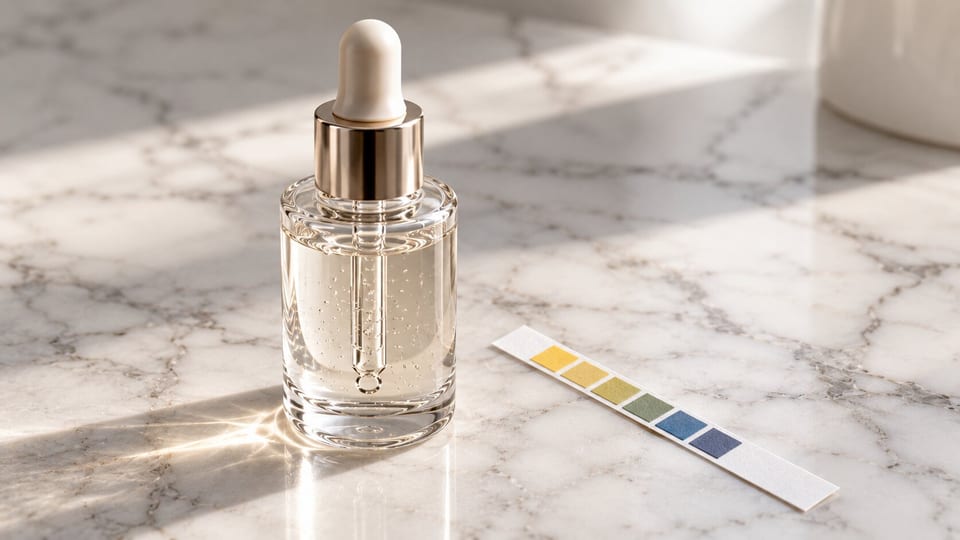
Two serums can list the same vitamin C at the same percentage and behave completely differently. pH is usually why.
What pH changes
Skin's outer layer is a barrier built to keep water-soluble things out. L-ascorbic acid is water-soluble and carries a charge at neutral pH, and charged molecules cross that barrier poorly. Lower the formula's pH and the molecule becomes largely uncharged, which is the state that gets through.
This is why the usual formulation guidance for L-ascorbic acid serums puts them below roughly pH 3.5. Above that, a serum can contain plenty of vitamin C and still deliver little of it.
Why derivatives are different
Derivatives such as THD, SAP and MAP are built to cross the barrier without needing an acidic environment, then convert in the skin. A derivative serum sitting near neutral pH is not badly formulated — it is formulated for a different mechanism. Judging it by the L-ascorbic acid pH rule is a category error.
What low pH means for your skin
- Stinging. Most of the sharp bite people associate with vitamin C is the acidity, not the vitamin C. It usually settles as skin adjusts.
- Barrier stress. Daily low-pH products on already-compromised skin can prolong irritation. If your barrier is unhappy, repair first.
- Layering. Applying an acidic serum alongside other acids stacks the irritation. See vitamin C with AHAs and BHAs.
Things pH does not mean
Lower is not better. Below about pH 3 you add sting and barrier stress without a matching gain. And pH is not a stability guarantee — an acidic serum still oxidises with air, light and heat. That is a packaging and storage question, covered in how to store vitamin C serum.
How to find out a serum's pH
Most brands do not print it. In practice:
- Check the brand's own FAQ or product page — some do publish it.
- Look at the form. An L-ascorbic acid serum from a brand that explains its formulation is usually built acidic; a derivative serum usually is not.
- Test strips work on a watery serum, roughly. They are fiddly and approximate on thicker textures.
If a brand markets pure L-ascorbic acid and says nothing about pH or packaging anywhere, that silence is itself information.
What to do with this
If you tolerate acids, an acidic L-ascorbic acid serum in protective packaging is the most direct route. If low pH leaves your skin tight or red, move to a derivative rather than pushing through — you are not getting extra credit for the sting. Compare forms across every serum we track, or start with the form comparison.
Common questions
What pH should a vitamin C serum be?
For L-ascorbic acid, the usual formulation guidance puts it below about pH 3.5 so the molecule can cross the skin barrier. Derivative serums are built to work near neutral pH and do not need to be acidic.
Is a lower pH always better?
No. Below roughly pH 3 you add stinging and barrier stress without a matching gain. Very low pH is a formulating cost, not a quality badge.
How can I tell my serum's pH?
Most brands do not print it, though some publish it in their FAQ. Test strips give a rough reading on a watery serum but are unreliable on thicker textures.
Does pH affect how I layer it?
Yes. An acidic serum stacks with exfoliating acids, so keeping vitamin C in the morning and acids in the evening removes most of the irritation risk.
Compare vitamin C serums sold in India → or browse ingredient explainers and picks by skin type and budget.
More from the blog
- Why Vitamin C Serums Are Starting to Add Carnosine and Other Anti-Glycation ActivesIngredients · 3 min read
- L-Ascorbic Acid vs Vitamin C Derivatives: Which Form Should You Pick?Ingredients · 3 min read
- How to Read the Efficacy Claims on a Vitamin C SerumGuide · 2 min read
- Nine Vitamin C Serum Myths Worth DroppingMyths · 3 min read
We are not dermatologists. This content is for informational purposes only — consult a qualified professional for medical advice. See our editorial policy and medical disclaimer.