
A Cheap Colour-Change Test Can Measure Vitamin C in Serums, Turkish Chemists Report
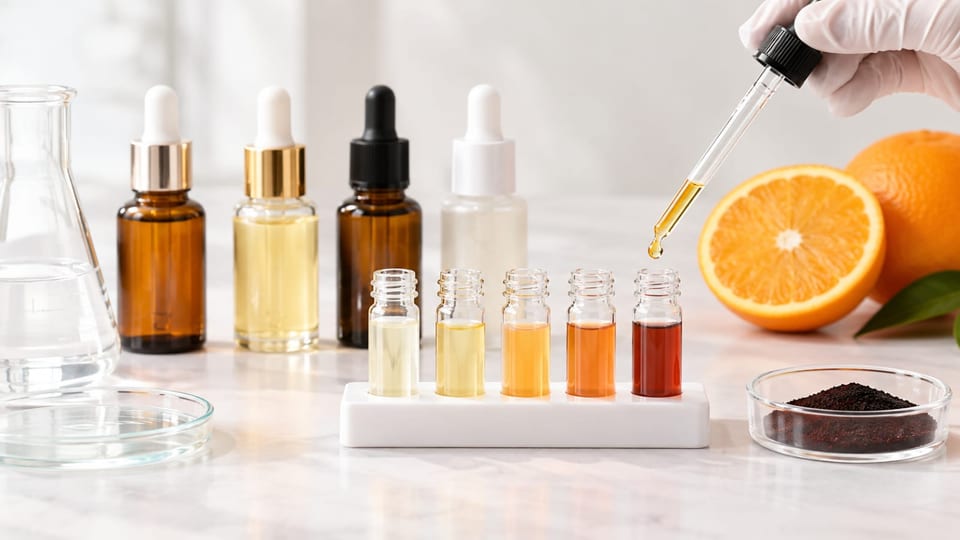
Pure vitamin C (L-ascorbic acid) breaks down when exposed to air, light and heat, which is why a serum can lose strength on the shelf. Checking how much is actually left in a product normally needs laboratory equipment such as liquid chromatography. A paper published online on 28 September 2026 in Analytical Methods, a Royal Society of Chemistry journal, describes a simpler option.
The chemists, from the chemistry department of Muğla Sıtkı Koçman University in Türkiye, used tiny particles of an iron oxide (γ-Fe2O3) that behave like an enzyme. In the presence of hydrogen peroxide they turn a test chemical blue. Ascorbic acid reverses that colour change, so the fainter the blue, the more vitamin C is in the sample. Reading the colour with a spectrophotometer gives a measurement.
The team reports that the method detects very low concentrations and was not thrown off much by the other ingredients in commercial formulas. They describe it as the first use of this kind of sensor on dermatological vitamin C serums. They tested five commercial serums and one dietary supplement, and recovered between about 98% and 104% of the vitamin C in the serums and 91% in the supplement.
Those recovery figures are easy to misread. In analytical chemistry, recovery usually means checking whether the method finds a known amount of the substance that the researchers know is there, often added on purpose. It measures how accurate the test is, not whether a product contains what its label promises. The abstract does not name the serums or report their vitamin C content against their labels.
For shoppers the practical point is indirect. Cheaper, faster tests could make it easier for manufacturers, regulators or independent labs to check vitamin C levels and spot degraded stock. Until such checks are routine, the usual signs still apply: opaque or airless packaging, a reasonable use-by period after opening, and a serum that has not turned dark orange or brown.
AI-assisted summary, rewritten from reporting by Analytical Methods (via PubMed).
Read the original article at Analytical Methods (via PubMed)Compare vitamin C serums sold in India → or read our vitamin C guides and ingredient explainers.
More vitamin C news
We are not dermatologists. This content is for informational purposes only — consult a qualified professional for medical advice.