
Trial: A 2% Vitamin C Rinse Cut Chest and Throat Discomfort After Iodine-Stain Endoscopy
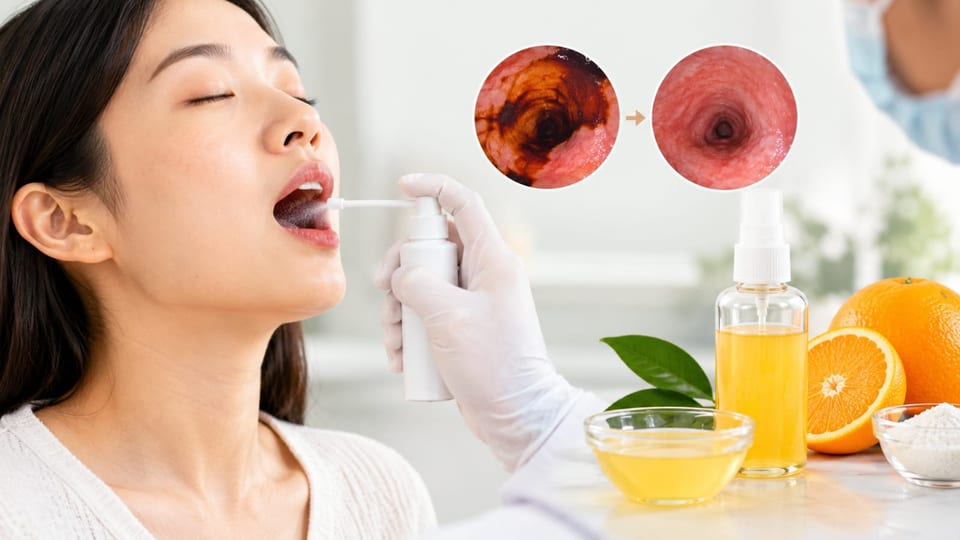
Vitamin C reacts readily with iodine, which is why it turns brown iodine solutions colourless. A randomised trial published online in September 2026 in Clinical and Translational Gastroenterology used that chemistry in an endoscopy room rather than a bathroom cabinet.
During some upper endoscopies, doctors spray Lugol's iodine solution on the lining of the food pipe (oesophagus). Healthy lining stains brown while early cancerous or precancerous patches stay pale, which makes them easier to spot. The drawback is that the iodine can leave people with burning behind the breastbone or in the throat for a while afterwards.
Gastroenterologists at the First Affiliated Hospital of Shihezi University and two regional hospitals in Xinjiang, China, randomly assigned 748 people who had Lugol staining to one of three rinses sprayed on afterwards: ordinary saline, a 2% vitamin C solution, or a 10% N-acetylcysteine solution. Patients and assessors did not know which rinse was used. The main analysis covered 681 people with complete results.
The difference was large. Fifteen minutes after the procedure, about 44% of the saline group reported symptoms, against about 9% in each of the two active groups. At thirty minutes it was roughly 32% with saline against about 4% with either active rinse. Both active solutions also removed the brown stain almost immediately: complete decolourisation took a median of 6 seconds with vitamin C and 12 seconds with N-acetylcysteine, compared with more than three minutes for saline. The authors say the direct comparison between vitamin C and N-acetylcysteine was exploratory, so the trial does not show that one is better or that they are equivalent.
The results are reported in the published abstract; the full paper was not openly available when we read it, so details such as trial registration and funding could not be checked. Symptoms were measured only in the first half hour.
For readers of this site, the useful takeaway is about chemistry, not skincare. The trial used a sterile medical solution sprayed by a doctor inside the oesophagus, and it does not suggest swallowing or gargling a face serum. It is, though, a neat clinical example of what vitamin C does best: it gives up electrons easily. That same property lets it neutralise free radicals on the skin, and it is also why vitamin C serums oxidise and turn darker once air gets at them.
AI-assisted summary, rewritten from reporting by Clinical and Translational Gastroenterology (abstract via Europe PMC).
Read the original article at Clinical and Translational Gastroenterology (abstract via Europe PMC)Compare vitamin C serums sold in India → or read our vitamin C guides and ingredient explainers.
More vitamin C news
We are not dermatologists. This content is for informational purposes only — consult a qualified professional for medical advice.