
Encapsulated and Liposomal Vitamin C Serums: What the Label Can and Cannot Tell You
More vitamin C serums now promise encapsulated, liposomal or capsule delivery. Here is what encapsulation is meant to solve, what the research behind it usually looks like, and how to read these claims.
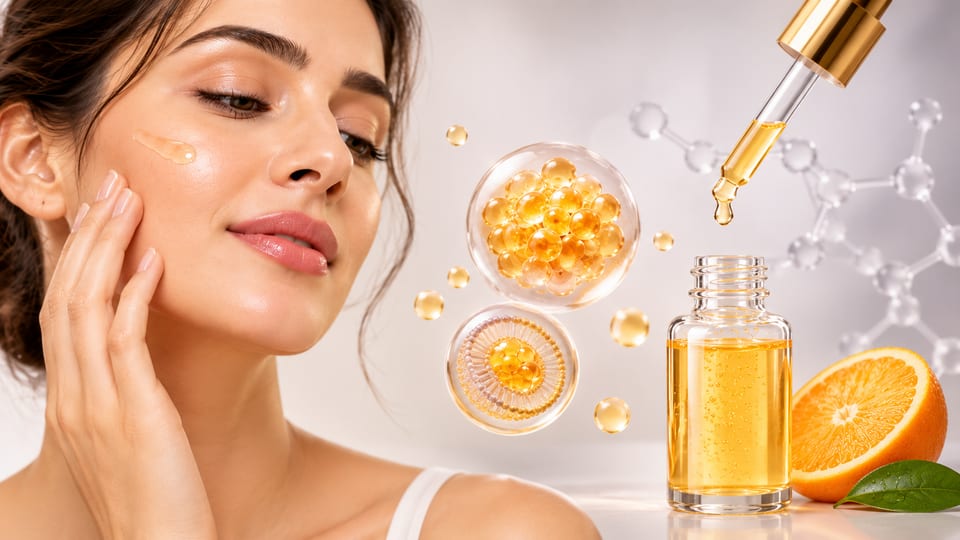
Words like encapsulated, liposomal and capsule technology now appear on many vitamin C serum labels. Some brands use them to describe a stabilised form of vitamin C; others use them for visible beads or pearls floating in the serum. They all point to the same idea: wrap the vitamin C in something that protects it and helps it get into skin. That idea is reasonable. Whether a particular serum delivers on it is a separate question, and the label alone rarely answers it.
The problem encapsulation is trying to solve
Pure vitamin C, L-ascorbic acid, has two well-known weaknesses. It breaks down quickly in water once it meets air, light and heat, which is why many serums turn yellow and then brown. And it dissolves readily in water but poorly in oils, while the outer layer of skin is built to keep water-loving substances out. A 2026 letter in the Journal of Cosmetic Dermatology sums this up: because vitamin C is so strongly water-loving, making a stable product that penetrates well without harming the skin barrier remains hard.
Formulators have several ways around this. One is to lower the pH and keep water and air out, as many classic L-ascorbic acid serums do. Another is to use a derivative, a modified form of vitamin C that is more stable (see our guide to L-ascorbic acid versus derivatives). Encapsulation is a third route: the vitamin C, or a derivative, is placed inside a tiny carrier.
The main kinds of carriers
- Liposomes are small spheres made of phospholipids, the same kind of fat that forms cell membranes. Water-soluble vitamin C can sit in their watery core.
- Niosomes are similar spheres made from non-ionic surfactants instead of phospholipids.
- Solid lipid nanoparticles and nanostructured lipid carriers use solid, or mixed solid and liquid, fats. A 2026 review in BioImpacts describes them as offering stability, controlled release and better targeting of the outer skin layer.
- Cyclodextrins are ring-shaped sugar molecules that can hold part of an ingredient inside the ring.
- Visible capsules or pearls are larger beads that burst when you rub the serum in. Their main job is usually to keep the vitamin C apart from the rest of the formula until use.
A label rarely says which of these is used, how much of the vitamin C is actually inside the carrier, or how big the particles are. Those details matter more than the word on the front.
What the evidence usually looks like
Most research on encapsulated vitamin C is done in the lab, not on people. Typical studies measure how much passes through a synthetic membrane, through pig or donated human skin in a diffusion cell, or into skin cells and lab-grown skin models. Those tests are useful for comparing formulas, but they do not show that a serum brightens or firms skin on a face. The BioImpacts review lists limited clinical validation among the open problems for lipid nanocarriers in general.
Two 2026 papers show how to read this kind of work.
- A study in Drug Delivery tested niosomes made from a specific surfactant. In cell cultures and lab-grown skin, the niosomes increased the penetration of a fluorescent dye about threefold, and encapsulated ascorbic acid helped protect cells against a damaging chemical. That is a promising lab result, but the penetration test used a dye rather than vitamin C, no human skin or volunteers were involved, and the carrier is a trademarked ingredient of the company several authors work for.
- The Journal of Cosmetic Dermatology letter compared three unnamed commercial products on a synthetic membrane. At 72 hours an encapsulated sodium ascorbate product had absorbed no more than a plain 15% L-ascorbic acid serum. The product that came out best was a non-encapsulated oil-soluble derivative, and the work was sponsored by a brand that sells that kind of product.
Human studies are rarer and often small. In a 2026 trial in the Journal of Clinical and Aesthetic Dermatology, an unnamed encapsulated vitamin C serum applied for four days did not reduce UV redness compared with untreated skin in 15 volunteers, while the sponsor's own multi-antioxidant serum did. That is a short test of one product, not a verdict on encapsulation, but it is a reminder that the technology does not guarantee a result.
Notice a pattern: much of this research is funded by companies that make one of the products or carriers being tested. That does not make it wrong, but it is a reason to look for independent repeats before treating a claim as settled.
How to read encapsulation claims on a serum
- Look for the vitamin C ingredient in the INCI list. Encapsulation describes packaging at the molecular level, not the ingredient itself. Check whether it is ascorbic acid, sodium ascorbate, ascorbyl glucoside, 3-O-ethyl ascorbic acid or another form.
- Look for a percentage. A serum that names its carrier but not its vitamin C strength gives you less to compare than one that states both.
- Ask what the supporting test measured. A membrane or skin-cell result is a formulation finding. A claim about brighter skin needs a test on people, ideally with a comparison group.
- Check who paid for it. Brand-funded tests are common and can be useful, but independent confirmation counts for more.
- Judge stability with your eyes too. Encapsulated or not, a serum that turns dark brown has likely oxidised. Our storage guide explains how to slow that down.
The bottom line
Encapsulation is a genuine formulation tool aimed at real weaknesses of vitamin C, and some carriers perform well in lab tests. What it is not, on its own, is evidence that a serum works better on your skin. Treat the word as a description of how the product is made, then judge the serum the way you would any other: by its vitamin C form and strength, its packaging, how your skin tolerates it and, above all, daily sunscreen. To compare serums with live prices and ratings, see our serum list.
Compare vitamin C serums sold in India → or browse ingredient explainers and picks by skin type and budget.
More from the blog
- Vitamin C and Tranexamic Acid Serums: What the Pairing Can and Cannot DoIngredients · 5 min read
- Vitamin C, E and Ferulic Acid: Why This Serum Trio Keeps Showing UpIngredients · 4 min read
- Penetration Enhancers in Vitamin C Serums: What Transcutol and Glycols Actually DoIngredients · 5 min read
- Vitamin C and Green Tea (EGCG) Serums: What the Pairing Can and Can't DoIngredients · 5 min read
We are not dermatologists. This content is for informational purposes only — consult a qualified professional for medical advice. See our editorial policy and medical disclaimer.