
Vitamin C and Green Tea (EGCG) Serums: What the Pairing Can and Can't Do
Green tea extract and its main catechin, EGCG, now turn up in many vitamin C serums. Here is what the small body of human research shows, why stability matters, and how to read the label.
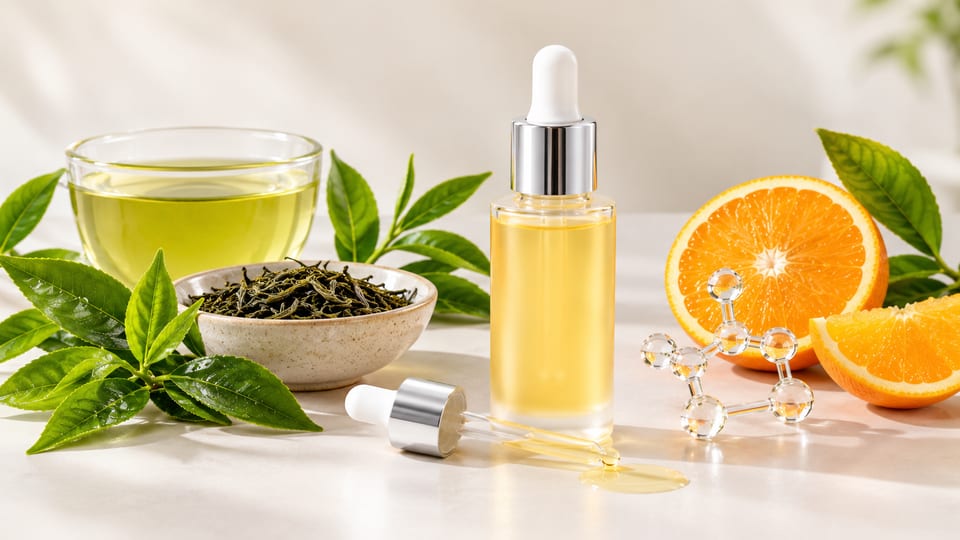
Green tea is one of the most common partners for vitamin C on a serum label. Some products name green tea extract, some name EGCG, the main catechin in tea leaves, and a few add caffeine as well. The idea behind the pairing is simple: both are antioxidants, so together they should mop up more of the free radicals that sunlight and pollution create in skin. The human evidence is thinner than the marketing suggests, so this guide sets out what is known.
What green tea extract and EGCG are
Green tea extract comes from the leaves of Camellia sinensis. Its active compounds are polyphenols called catechins. The four main ones are epigallocatechin gallate (EGCG), epigallocatechin, epicatechin gallate and epicatechin. EGCG gets most of the attention because it is the most abundant and the most studied. In lab work on skin cells it acts as a free radical scavenger, which means it neutralises reactive molecules after they form, rather than stopping them from forming.
Vitamin C is also a scavenger, but it does other jobs too. It is needed for collagen production and it slows melanin formation, which is why it is sold for brightening and dark spots. Green tea catechins have their own reported effect on pigment: they can block tyrosinase, the enzyme skin uses to make melanin. On paper, then, the two overlap on antioxidant protection and pigment, and differ elsewhere.
What human studies show
A systematic review published in the Journal of Cosmetic Dermatology in 2026 (Lubbers and colleagues) looked for every controlled human study of green tea extract containing EGCG applied to the face for signs of ageing. From 481 records the authors kept only seven studies. That number alone says a lot about the state of the evidence.
The studies were small and varied. Three used a split-face design, where one side of the face acts as the control. One followed a single person. Most enrolled only women, and the strength of the green tea ranged enormously, from a cream with a tiny fraction of a percent of EGCG to a 10 percent extract. Each study also measured results differently, so the authors could not pool them into a meta-analysis.
With those limits in mind, the pattern was mostly positive:
- Fine lines: four of the five studies that measured wrinkles reported fewer fine lines; only one reported any change in deeper wrinkles.
- Elasticity: every study that measured it found some improvement.
- Pigment: two of the three studies that looked at it found less melanin or fewer dark areas; the third came close but did not reach significance.
- Redness: results were mixed. Most studies found no irritation, but they also did not show a clear calming effect on redness.
The authors concluded that green tea extract shows potential as an anti-ageing ingredient for facial skin, but that the research is too sparse and inconsistent for firm conclusions.
Is the combination with vitamin C proven?
Not really. Only one study in the review combined green tea with vitamins C and E, and it was a cohort study without a separate group using green tea alone or vitamin C alone. Several other studies paired green tea with a different extra treatment, such as an enzyme or red light. The review points out that when two ingredients are tested together, it is impossible to say which one produced the result. So a serum that combines them may work well, but there is no good evidence yet that the pair does more than either ingredient would on its own.
Dose matters, and more is not better
One trial in the review used a green tea dose far higher than the others. In that study the dermatologists saw no irritation, yet patients reported dryness and three people dropped out. The researchers put this down to the high dose. It is a useful reminder that a bigger number on the label is not automatically an improvement, for green tea or for vitamin C.
The stability problem
EGCG shares a weakness with pure vitamin C: it breaks down easily and does not pass through skin well. Reviews of EGCG for sun-damaged skin note that this poor stability and low uptake is why formulators turn to modified forms of EGCG, special delivery systems or combinations with other ingredients. That is why you may see names such as an EGCG glucoside on an ingredient list rather than plain EGCG.
For you, the practical point is that two fragile antioxidants in one bottle need careful packaging and storage. An opaque or airless pack, a cool shelf and finishing the bottle within the period printed on it all help. Our guide on how to store vitamin C serum covers this in detail.
How to read a green tea and vitamin C label
- Extract is not the same as EGCG. A label that says one percent green tea extract may contain only a very small amount of EGCG; one study in the review used exactly that kind of formula. A named EGCG form is more informative than a vague extract.
- Check the vitamin C form and strength separately. The green tea does not change how much vitamin C is in the bottle. Our guide to L-ascorbic acid and its derivatives explains the common forms.
- Caffeine is a separate claim. Many green tea serums add caffeine. Judge it as its own ingredient; the green tea research above does not cover it.
- Treat clinical claims as brand claims. A line such as clinically proven usually refers to the brand's own test, often small and unpublished. Look for the study size and length before giving it much weight.
- Patch test first. Plant extracts and fragrance are common in these formulas and can irritate some skin, even when the active ingredients are gentle.
Where it fits in a routine
A vitamin C and green tea serum goes in the same place as any vitamin C serum: after cleansing, before moisturiser, usually in the morning, and always followed by sunscreen. Antioxidants support sunscreen but do not replace it. If you already use a separate antioxidant serum, you do not need to stack a second one; see how to layer vitamin C in your routine.
The bottom line
Green tea extract and EGCG are reasonable partners for vitamin C. Small human studies point to modest gains in fine lines, elasticity and pigment, and the ingredient is usually well tolerated at sensible doses. What is missing is proof that the combination beats either ingredient alone, and stability is a real challenge. Choose on the vitamin C form, strength and packaging first, and treat the green tea as a possible bonus. To compare current options with live prices and ratings, see our serum listings.
Compare vitamin C serums sold in India → or browse ingredient explainers and picks by skin type and budget.
More from the blog
- Penetration Enhancers in Vitamin C Serums: What Transcutol and Glycols Actually DoIngredients · 5 min read
- Vitamin C and Exosome Serums: What the Label Can and Cannot Tell YouIngredients · 5 min read
- Vitamin C and PDRN Serums: What the Evidence Actually CoversIngredients · 4 min read
- Vitamin C With Alpha-Arbutin and Kojic Acid: Do Brightening Combinations Work Better?Ingredients · 4 min read
We are not dermatologists. This content is for informational purposes only — consult a qualified professional for medical advice. See our editorial policy and medical disclaimer.