
Vitamin C and Exosome Serums: What the Label Can and Cannot Tell You
Exosomes are the newest ingredient on vitamin C serum labels, usually from plants like Centella. Here is what they are, what the research covers so far, and how to judge a serum that adds them.
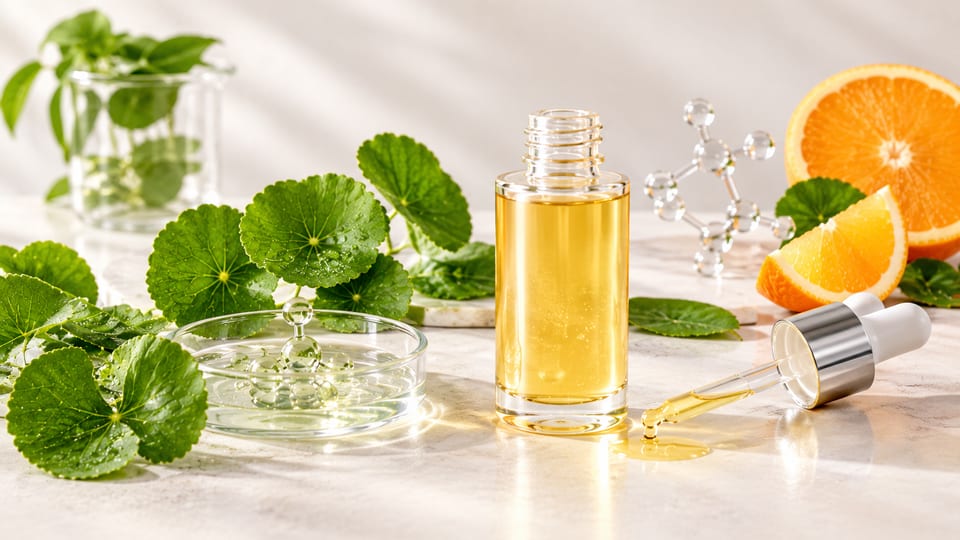
Exosomes have moved from clinic treatments to the shelf. A few years ago the word mostly appeared on in-clinic treatments after lasers or microneedling. Now it is printed on serum bottles, often next to vitamin C, and often with a plant name in front of it: cica exosomes, ginseng exosomes, rice exosomes. The pitch is that vitamin C brightens while exosomes repair. Before paying extra for that pairing, it helps to know what an exosome is and how much of the research applies to a bottle on a bathroom shelf.
What exosomes are
Exosomes are tiny, membrane-wrapped packets that cells release. They carry proteins, fats and fragments of genetic material such as microRNA, and cells use them to pass signals to one another. In the body they are part of ordinary cell-to-cell communication, which is why researchers became interested in using them to nudge skin cells toward repair.
There are two very different families, and the label rarely spells out which one you are getting:
- Animal or human-derived exosomes, usually collected from stem cells grown in a lab. A 2025 review in the Journal of Nanobiotechnology puts them at roughly 30 to 150 nanometres and notes that their use raises questions about immune reactions and the possibility of carrying viruses.
- Plant-derived exosome-like nanovesicles, which is what most skin care means by "cica exosomes" or similar. The same review describes them as larger, roughly 50 to 500 nanometres, carrying plant compounds and plant microRNAs. Researchers have isolated them from ginseng, green tea, Centella asiatica and many fruits and vegetables.
The plant versions are the ones you will mostly see in serums sold in India. They are not the same thing as stem-cell exosomes used in clinics, so results from one do not transfer to the other.
What the research covers so far
Two recent reviews, one in International Journal of Biological Sciences (2024) on exosomes in dermatology and one in the Journal of Nanobiotechnology (2025) on plant exosome-like vesicles for skin, describe a field that is promising but early. Most of the findings come from skin cells in a dish and from mice. Lab work has linked plant vesicles to antioxidant and anti-inflammatory activity, to effects on melanin production and to wound healing.
Human trials are scarce, and the ones the plant review highlights are mainly about hair loss, including a small pilot randomised trial of a plant exosome formula for male pattern hair loss. The dermatology review points out a basic problem with leaning on animal studies: mouse skin is built differently from human skin, so mouse results cannot reliably predict what happens on a face. Neither review offers a body of controlled human trials showing that a plant exosome serum fades pigmentation or improves texture better than a serum without it.
Three problems a label does not solve
No standard for what is in the bottle. The plant review stresses that yield and purity vary widely between batches, even when the same method is used, depending on the plant species, the harvest season and how fresh the material was. It reports that ginseng vesicle yields from the same techniques ranged roughly threefold across studies. There is no agreed way to count or measure them yet. So "1% exosomes" on a pack usually describes how much of an ingredient solution went in, not how many intact vesicles reach your skin.
Storage. The same review notes that research-grade plant vesicles are temperature-sensitive and are typically stored at minus 80 degrees Celsius, and that freezing and thawing can damage them. Keeping them intact at room temperature, in a bathroom, for months after opening is an unsolved problem in the published work, not a solved one. A brand may have its own stability data, but it is rarely published.
Long-term safety is untested. Plant vesicles look well tolerated in lab and animal studies, and the review calls them low in immune reactivity. It also says that the long-term effects of applying them to skin, including allergy and build-up in the skin, still need proper study.
Does pairing them with vitamin C make sense?
Nothing in the reviews shows that exosomes boost vitamin C, or the other way round. Researchers are interested in plant vesicles as carriers that might help other ingredients cross the outer layer of skin, but that is a research direction, not something shown for vitamin C serums on sale. One small detail from the plant review is worth knowing: vesicles isolated from orange juice did not contain vitamin C. A fruit name next to the word exosome does not mean the vesicles are delivering vitamin C.
In practice, the vitamin C part of the formula is the part you can actually judge. Its form and strength are measurable, and there is a much larger body of evidence behind it.
How to judge a vitamin C and exosome serum
- Check the vitamin C first. Which form is it, and at what percentage? Exosome serums often carry a lower vitamin C strength than a straightforward vitamin C serum. Our guide to L-ascorbic acid and its derivatives explains how forms differ, and the concentration guide covers strength.
- Ask what kind of exosome. A plant source should be named. If the label does not say whether the exosomes come from plants or from human or animal cells, treat the claim cautiously.
- Read the claims as claims. Phrases like "repairs at a cellular level" describe what the brand hopes the ingredient does. Look for a named human study on the finished product, with a control group. Our post on reading vitamin C serum claims walks through what to look for.
- Compare the price with a plain serum. If you mainly want brightening, a well-made vitamin C serum without the trend ingredient may do the same job for less. Live prices and ratings are on our serum list.
- Patch test. New ingredient families mean less real-world information about reactions. Try it on a small area first, especially on sensitive skin.
Exosomes may turn out to be useful in skin care. For now, the strongest reason to buy a vitamin C and exosome serum is still the vitamin C. We covered a similar trend ingredient in vitamin C and PDRN serums.
Compare vitamin C serums sold in India → or browse ingredient explainers and picks by skin type and budget.
More from the blog
- Penetration Enhancers in Vitamin C Serums: What Transcutol and Glycols Actually DoIngredients · 5 min read
- Vitamin C and Green Tea (EGCG) Serums: What the Pairing Can and Can't DoIngredients · 5 min read
- Vitamin C and PDRN Serums: What the Evidence Actually CoversIngredients · 4 min read
- Vitamin C With Alpha-Arbutin and Kojic Acid: Do Brightening Combinations Work Better?Ingredients · 4 min read
We are not dermatologists. This content is for informational purposes only — consult a qualified professional for medical advice. See our editorial policy and medical disclaimer.