
Vitamin C and PDRN Serums: What the Evidence Actually Covers
PDRN, the DNA-based ingredient behind salmon injections, is now turning up in vitamin C serums. Here is what PDRN is, where its research comes from, and why results from injections do not automatically carry over to a bottle.
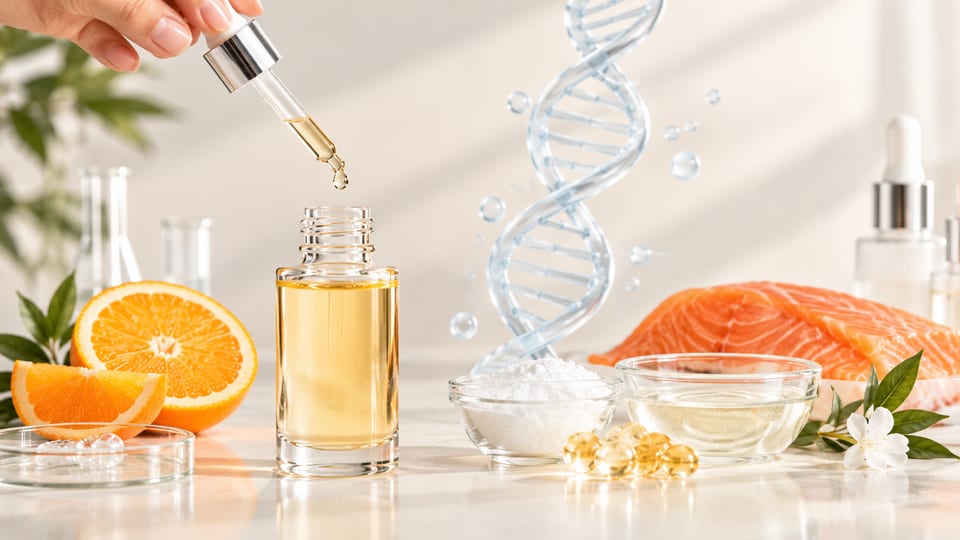
PDRN has gone from clinic menus to serum labels in a very short time. Korean brands built it into their 2026 launches, global luxury houses followed, and vitamin C serums that add PDRN are now easy to find. The pitch is appealing: vitamin C for brightness, PDRN for repair. Before paying extra for the combination, it helps to know where PDRN's reputation comes from and how much of it applies to something you smooth onto your face.
What PDRN is
PDRN stands for polydeoxyribonucleotide. It is a mixture of short DNA fragments. A closely related ingredient, PN or polynucleotide, is made of longer DNA chains. A 2025 review in Pharmaceutics described the two as related but not interchangeable: longer PN chains are linked mainly to support for the skin's structural matrix, while shorter PDRN fragments are thought to act through adenosine receptors on skin cells and to supply building blocks the cells can reuse.
Traditionally, PDRN is extracted from salmon or trout DNA, which is where the "salmon DNA facial" name comes from. Newer cosmetic versions are made from plants, usually from cell cultures, callus or roots, and are marketed as animal-free.
Where the evidence comes from
Most of PDRN's track record comes from medicine and aesthetic clinics, not from serums. It was first studied for wound healing, and in aesthetics it is mainly injected into the skin, often as part of "skin booster" treatments. Even there, the evidence is still developing. A 2025 systematic review in the Journal of Cosmetic Dermatology found nine studies of polynucleotide injections covering 219 patients. The studies reported improvements in wrinkles, texture and elasticity with mostly mild side effects, but the reviewers rated the studies as low to moderate quality and called for more rigorous trials.
Injected PDRN is placed directly in the dermis. A serum has to get there on its own, and that is the hard part.
The skin barrier problem
The outer layer of skin, the stratum corneum, is very good at keeping large, water-loving molecules out, and DNA fragments are both. A July 2026 review of plant-derived PN and PDRN in the Journal of Functional Biomaterials also pointed out that this outer layer contains enzymes that break DNA down. The same review noted that microneedles and use after skin procedures matter precisely because they get around the intact barrier.
That review was frank about plant-derived PDRN in particular. Its authors wrote that the evidence is still mainly preclinical, that it should not be read as proof that plant PDRN works the same way as the animal-derived kind, and that direct comparisons with matched dose, fragment size and purity are limited. Some of the biological effects seen in lab work overlap with classic PDRN, but the authors treated the mechanism as a working hypothesis for most plant preparations.
What about PDRN with vitamin C?
The most direct study of the combination is a 2022 paper in Molecules that tested a liquid of PDRN, vitamin C and niacinamide against UV-B damage. It is useful, but it is not evidence for a serum used at home. The tests were done on animal skin, and the mixture was delivered with a microneedling system, which bypasses the barrier described above. In that setting the combination reduced pigment-related markers and protected collagen and elastin fibres, and hydroquinone and PDRN alone were also tested for comparison.
Vitamin C's own case is far stronger. Its antioxidant and brightening effects have been studied in people for decades, especially for L-ascorbic acid at a low pH and for some stable derivatives. In a PDRN serum, it is usually the vitamin C, the niacinamide and the overall formula that you can count on, with PDRN as the less certain extra.
How to judge a vitamin C and PDRN serum
- Check the vitamin C first. Look for the form and, ideally, the percentage. A PDRN serum with an unnamed, low-dose vitamin C is not a strong vitamin C serum. Our guides to vitamin C forms and concentrations explain what to look for.
- Ask where the PDRN comes from. Salmon, other fish or plant sources are all used. Brands rarely give the amount or fragment size, so treat PDRN as a supporting ingredient unless they do.
- Read the claims carefully. Results from injections, clinic treatments or microneedling do not prove what a leave-on serum will do. Brand figures based on a few dozen people rating how their skin looks are a weak basis for a big price difference. Our guide to reading serum claims covers this in more detail.
- Do not use a serum as an aftercare product without advice. If you have had microneedling, a laser or a peel, follow your clinician's instructions on when to restart actives, including vitamin C. See our note on vitamin C after procedures.
- Keep sunscreen as the base. No antioxidant or repair ingredient replaces daily broad-spectrum sun protection.
The bottom line
PDRN is a promising ingredient with a real but still developing clinical record, mostly from injections. In a vitamin C serum, it may add something, but the evidence that it reaches the right layer of skin and works there, especially in plant-derived form, is not yet in place. Choose the serum for its vitamin C, its formula and its packaging, and see PDRN as a bonus rather than the reason to pay more. You can compare vitamin C serums sold in India, with current prices and ratings, on our serums page.
Compare vitamin C serums sold in India → or browse ingredient explainers and picks by skin type and budget.
More from the blog
- Penetration Enhancers in Vitamin C Serums: What Transcutol and Glycols Actually DoIngredients · 5 min read
- Vitamin C and Green Tea (EGCG) Serums: What the Pairing Can and Can't DoIngredients · 5 min read
- Vitamin C and Exosome Serums: What the Label Can and Cannot Tell YouIngredients · 5 min read
- Vitamin C With Alpha-Arbutin and Kojic Acid: Do Brightening Combinations Work Better?Ingredients · 4 min read
We are not dermatologists. This content is for informational purposes only — consult a qualified professional for medical advice. See our editorial policy and medical disclaimer.