
Vitamin C and Peptides: Do They Work Together, and What Does the Evidence Say?
Serums increasingly pair vitamin C with peptides. Here is what each ingredient is meant to do, how thin the evidence for topical peptides still is, and how to layer the two without problems.
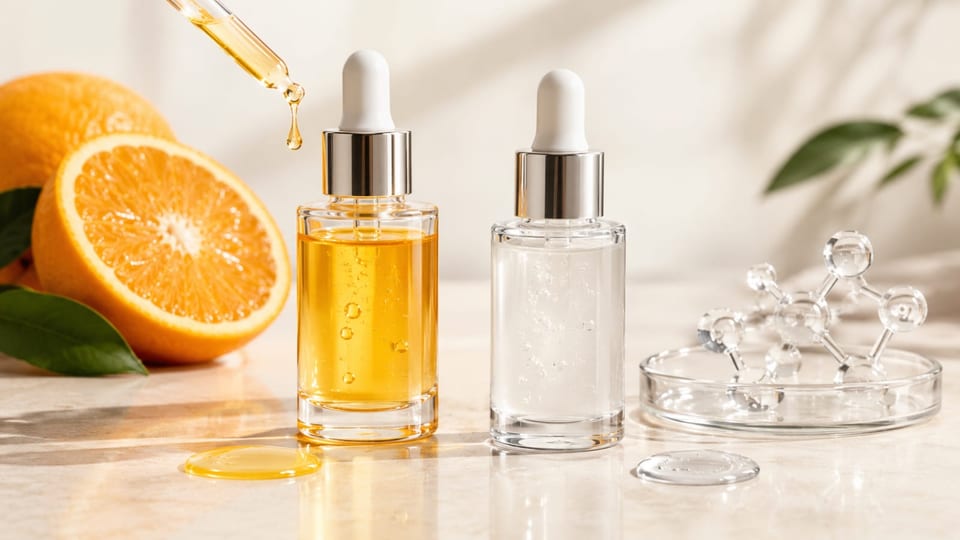
Peptides have become one of the most common words on serum labels, and more and more products now put them next to vitamin C. If you already use a vitamin C serum, it is fair to ask whether a peptide adds anything, whether the two can share a routine, and how much of the peptide story is backed by evidence. This guide covers what is reasonably well established and where the claims run ahead of it.
What a cosmetic peptide is
A peptide is a short chain of amino acids, the same building blocks that make up proteins such as collagen. In skincare, manufacturers make small synthetic peptides designed to send a particular signal to skin cells or to carry something into them. A review of topical peptides in the Indian Journal of Dermatology, Venereology and Leprology groups them into four broad families:
- Signal peptides, meant to prompt the cells that make collagen and other parts of the skin's support structure. Palmitoyl pentapeptide, sold under trade names such as Matrixyl, is the familiar example.
- Carrier peptides, which ferry trace elements into the skin. Copper peptides belong here.
- Neurotransmitter-inhibiting peptides, such as acetyl hexapeptide (often sold as Argireline), which are marketed as softening expression lines by damping muscle signals.
- Enzyme-inhibiting peptides, intended to slow the enzymes that break down collagen.
What vitamin C does that peptides do not
Vitamin C plays a different role. It is an antioxidant that helps neutralise the free radicals produced by sunlight and pollution, and it is also needed by the enzymes that finish building collagen. It is also the more established brightening ingredient of the two, with studies on uneven tone and dark spots. Peptides are mainly sold for firmness and fine lines, not for pigmentation. So the two are not substitutes. A peptide will not do vitamin C's antioxidant or brightening job, and vitamin C is not a signalling molecule in the way a signal peptide is meant to be.
That difference is the main reason brands pair them: the idea is that vitamin C protects and supports collagen building, while a signal peptide asks cells to make more. It is a sensible theory. As the evidence section below shows, it has not been well tested in people.
How strong is the evidence for peptides on skin?
Thinner than the marketing suggests. A 2026 systematic review and meta-analysis in Frontiers in Medicine pooled nineteen randomised controlled trials of peptides for skin ageing. Seventeen of them tested peptides taken by mouth, mostly collagen peptides, and only two tested peptides applied to the skin. The pooled benefit on wrinkles came mainly from the oral studies. For the topical trials, the authors described the effect as limited, and the pooled topical result on wrinkles was not statistically meaningful. The trials were short, generally four to twelve weeks, and very different from one another.
The Indian review reaches a similar conclusion from a different angle: peptides are attractive because they are selective, well tolerated and do not face pre-market approval for cosmetic use, but clinical evidence for many of them is weak, many are large molecules that do not pass easily through the skin barrier, and they can be expensive. None of this means peptides do nothing. It means a peptide on a label is not, by itself, proof that a product will firm your skin.
The same caution applies to the pairing. In the 2026 meta-analysis, the trials that combined peptides with vitamin C were oral supplements, not serums. We could not find good human trials showing that a topical peptide and topical vitamin C together beat either one alone.
Can you use them together?
For most people, yes. Peptide serums are usually gentle, and they are commonly layered with vitamin C. A few practical points help:
- Copper peptides are the one pairing to think about. Copper and pure L-ascorbic acid can react with each other, and many formulators advise against layering them at the same moment. A simple way around it is to use vitamin C in the morning and a copper peptide product at night. This caution applies mainly to copper peptides; most other peptides do not raise it.
- Mind the acidity. Pure L-ascorbic acid serums are formulated at low pH. Some peptides are less stable in strongly acidic conditions, which is one reason brands often keep them in separate products or use a vitamin C derivative when combining them in one bottle.
- Layer thin to thick. Apply the most watery serum first. If your vitamin C is a thin, acidic serum, let it settle for a minute before a peptide serum or moisturiser.
- Morning sunscreen is not optional. Neither ingredient replaces sun protection, and anything you hope to gain for firmness or tone is undone by daily unprotected sun.
- Patch test new combinations. Combining products increases the chance that something in one of them irritates. Introduce one new product at a time so you know what caused a reaction.
Reading a "vitamin C + peptide" label
When a single serum claims both, a few questions are worth asking. Does the label say which vitamin C form is used and at what strength, or only that vitamin C is "present"? Is the peptide named (for example palmitoyl tripeptide-1 or acetyl hexapeptide-8), and does it appear high enough in the ingredient list to matter? Are the results the brand quotes from tests on the finished product, or from studies of the raw ingredient at a different strength? A named form, a stated percentage and product-level testing are better signs than a long list of trendy actives.
If you are choosing a vitamin C serum first, our serum comparison shows current prices and sourced ratings. For other pairings, see our guides to vitamin C with niacinamide and vitamin C with retinol, and how to layer vitamin C in your routine.
The short version
Vitamin C and peptides do different jobs, and using both is generally safe, with copper peptides best kept to a different time of day from pure vitamin C. Vitamin C has the stronger evidence on the skin. Topical peptides are well tolerated but have only limited trial evidence for wrinkles so far, and the combination itself is untested in serums. If you add a peptide, treat it as an optional extra rather than the core of your routine.
Compare vitamin C serums sold in India → or browse ingredient explainers and picks by skin type and budget.
More from the blog
- Penetration Enhancers in Vitamin C Serums: What Transcutol and Glycols Actually DoIngredients · 5 min read
- Vitamin C and Green Tea (EGCG) Serums: What the Pairing Can and Can't DoIngredients · 5 min read
- Vitamin C and Exosome Serums: What the Label Can and Cannot Tell YouIngredients · 5 min read
- Vitamin C and PDRN Serums: What the Evidence Actually CoversIngredients · 4 min read
We are not dermatologists. This content is for informational purposes only — consult a qualified professional for medical advice. See our editorial policy and medical disclaimer.