
Vitamin C Serum Blog
Evergreen guides on using vitamin C: concentrations, layering order, what it can and cannot fix, and how to tell when a serum has turned. For dated launches and price changes see news, and for product data see all serums.

Vitamin C and Hyaluronic Acid Serums: What Each Ingredient Does in the Bottle
Vitamin C and hyaluronic acid are one of the most common pairings on serum labels. Here is what each one is there to do, what the research on hyaluronic acid size actually shows, and why most combination studies cannot separate the two.
11 Nov 2026
Vitamin C and Tranexamic Acid Serums: What the Pairing Can and Cannot Do
More brightening serums now pair vitamin C with tranexamic acid. Here is how each ingredient is thought to work on pigmentation, what the melasma studies actually compared, and what to check on the label.
9 Nov 2026
Encapsulated and Liposomal Vitamin C Serums: What the Label Can and Cannot Tell You
More vitamin C serums now promise encapsulated, liposomal or capsule delivery. Here is what encapsulation is meant to solve, what the research behind it usually looks like, and how to read these claims.
6 Nov 2026
Vitamin C, E and Ferulic Acid: Why This Serum Trio Keeps Showing Up
Many vitamin C serums now copy the same three-part recipe: L-ascorbic acid, vitamin E and ferulic acid. Here is what the original studies measured, what they did not, and how to read a 'C E Ferulic' label.
29 Oct 2026
Penetration Enhancers in Vitamin C Serums: What Transcutol and Glycols Actually Do
More vitamin C serums now advertise ingredients that help the vitamin C get into skin. Here is what solvents like Transcutol, propylene glycol and pentanediol do, what the lab studies show, and the EU's safety limit.
26 Oct 2026
Vitamin C and Green Tea (EGCG) Serums: What the Pairing Can and Can't Do
Green tea extract and its main catechin, EGCG, now turn up in many vitamin C serums. Here is what the small body of human research shows, why stability matters, and how to read the label.
25 Oct 2026
Vitamin C and Exosome Serums: What the Label Can and Cannot Tell You
Exosomes are the newest ingredient on vitamin C serum labels, usually from plants like Centella. Here is what they are, what the research covers so far, and how to judge a serum that adds them.
23 Oct 2026
Vitamin C and PDRN Serums: What the Evidence Actually Covers
PDRN, the DNA-based ingredient behind salmon injections, is now turning up in vitamin C serums. Here is what PDRN is, where its research comes from, and why results from injections do not automatically carry over to a bottle.
21 Oct 2026
Vitamin C With Alpha-Arbutin and Kojic Acid: Do Brightening Combinations Work Better?
Many dark-spot serums pair vitamin C with alpha-arbutin or kojic acid. Here is what each ingredient does, how strong the evidence is, and how to avoid irritation that can make pigment worse.
15 Oct 2026
Vitamin C and Peptides: Do They Work Together, and What Does the Evidence Say?
Serums increasingly pair vitamin C with peptides. Here is what each ingredient is meant to do, how thin the evidence for topical peptides still is, and how to layer the two without problems.
13 Oct 2026
Vitamin C and Glutathione in One Serum: What the Pairing Can and Can't Do
Brightening serums increasingly pair vitamin C with glutathione. Here is what each ingredient is meant to do, how strong the evidence is for putting glutathione on your skin, and how to read these labels.
12 Oct 2026
Why Vitamin C Serums Are Starting to Add Carnosine and Other Anti-Glycation Actives
Carnosine, neohesperidin and similar actives are turning up next to vitamin C in 2026 reformulations. They target glycation, which is a different problem from the one vitamin C solves.
6 Oct 2026
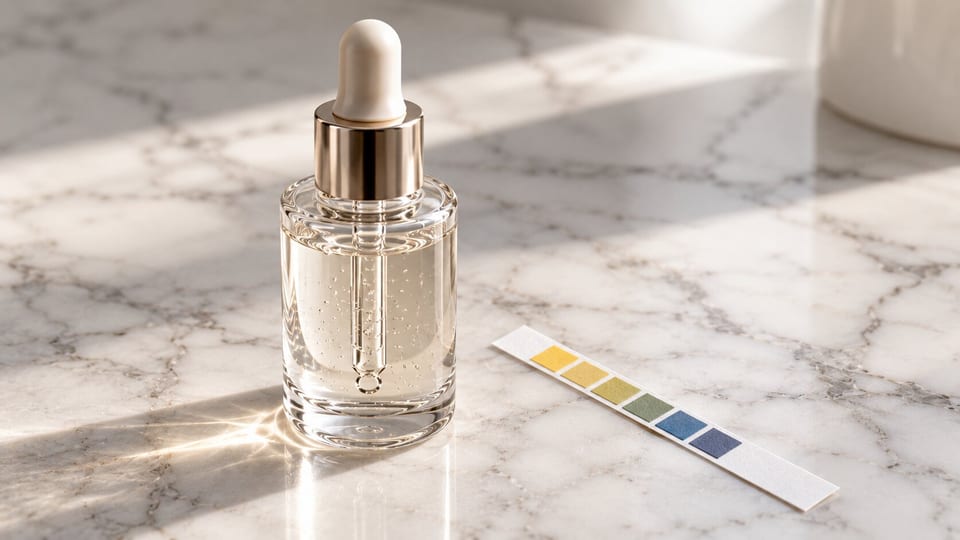
Vitamin C Serum pH: Why It Decides Whether Your Serum Works
pH is the number brands rarely print and the one that decides whether L-ascorbic acid gets into your skin at all. Here is what it does, and why derivative serums do not need to be acidic.
19 Sept 2026
L-Ascorbic Acid vs Vitamin C Derivatives: Which Form Should You Pick?
L-ascorbic acid is the most researched form of vitamin C and the least stable. Derivatives are gentler and last longer but have to convert in the skin. Here is how the main forms compare.
17 Sept 2026